By Autodesk
Embracing innovation sets the most successful construction businesses apart. Advanced technology is helping those companies thrive despite the labour shortage and increasing pressures on budgets and timelines.
“Architecture, engineering and construction (AEC) leaders are using technologies like AI, extended reality and robotics to reduce risk, save time and drive business growth,” says Amit Puri, Senior Manager of EMEA Technical Solutions at Autodesk.
“This tech is enabling the high degree of collaboration and coordination demanded by large-scale projects, and also becoming more accessible and equally valuable for smaller projects aiming to enhance productivity and gain a competitive edge.
“What once seemed futuristic is now becoming standard practice,” he adds. “In our rapidly evolving industry, it’s vital to adopt digital tools and stay prepared for what’s next to drive digital transformation. Companies that take a forward-looking and measured approach to innovation are already seeing real results.”
Here are the top 10 innovations already shaping the future of construction and what you need to know to keep up with the pace of change.
1. Artificial intelligence and machine learning
Using machine learning (ML) powered by artificial intelligence (AI), machines can predict outcomes based on current and historical data. For construction companies, these predictions become the basis for better-informed decisions, strategies and workflows.
BAM Ireland is one example. By adopting Construction IQ, powered by Autodesk AI, as a predictive analytics tool on its projects, BAM Ireland improved on-site quality and safety by 20%. And it freed up 25% more time to focus on high-value and high-risk issues.
Construction pros are also cutting admin time by using generative AI to create new content, including schedules, 3D designs and reports.
“AI is a way to give construction professionals superpowers: making them more efficient, making them smarter and making their lives better,” says Michael Perry, Director of product management, intelligence at Autodesk Construction.
2. Resource and workforce management software
The latest innovations in resource and workforce management solutions for construction include predictive tracking, forecasting and mobile-first interfaces.
Bridgit Bench, for example, is a workforce planning solution that lets contractors track pursuits, predict changes and forecast workforce needs. Project teams can push awarded and opportunity projects from Autodesk Construction Cloud to Bridgit Bench, keeping them up to date as they go.
One tool, Riskcast, helps crews easily capture data around labour, equipment and production without multiple systems and complex spreadsheets. Teams can sync real-time data into Autodesk Cost Management Performance Tracking to compare planned-vs-actual data.
3. 3D printing
Once a novelty, 3D printing building components layer by layer could one day become industry standard.
Smaller 3D printers can create scale models and prototypes using plastics or metal. Large-scale 3D printers can make everything from facades, parts and fixtures to entire structures typically using special concrete mixes.
Because it uses only as much material as necessary, 3D printing cuts construction waste. It also offers design freedom, speed and streamlined production. As it becomes more mainstream, it could potentially offer lower building costs than traditional methods.
4. XR, AR, VR and the Metaverse
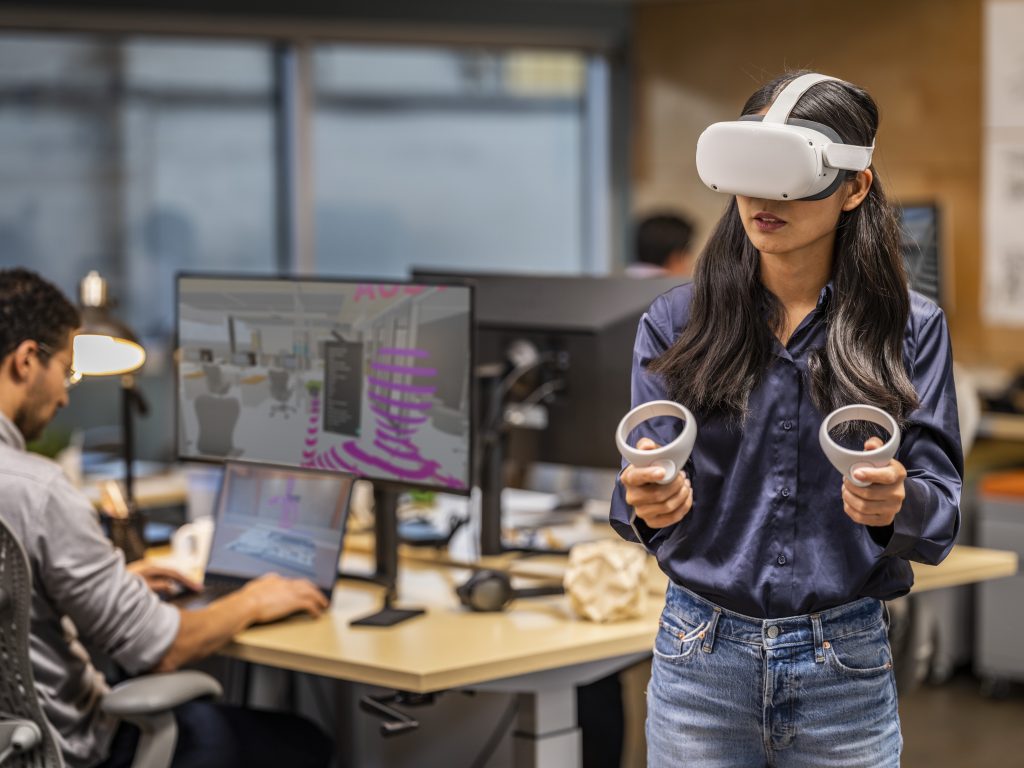
Extended reality (XR) is the umbrella term for virtual reality (VR), augmented reality (AR) and mixed reality (MR), all of which are being used in construction to drive collaboration, impact and efficiency.
On sites, VR is increasingly being used on mobile devices and headsets for construction site surveys and project visualisation, saving time and improving collaboration.
Meanwhile, project teams are using both AR and VR for remote site inspections, helping them identify and address critical safety issues faster, thereby saving money.
With innovations like Autodesk Workshop XR – an immersive design review workspace – AEC teams are finding new ways to use 3D models to track issues, prevent errors and enhance spatial understanding, ultimately improving workflows and integration.
5. Sensor data
Tracking manpower, job sites and equipment is essential for project planning and management, and ensures compliance with safety and worker regulations.
Construction sensors and IoT technology enable you to monitor site conditions, track materials through the supply chain, improve worker safety, monitor machinery and transform facility management.
“With the use of sensor data and Autodesk Platform Services (formerly Forge), we can predict future product failures,” explains Chris Schoneveld, BIM Manager at Dutch firm Alkondor Hengelo. “And doing multiple tasks on a single maintenance job benefits our company’s eco footprint by minimising traffic movement.”
6. Digital twins
A digital twin is a digital replica of a physical entity, including its current and potential assets, systems, data, processes, workflows, people and devices. Building out a digital twin from day one of a build project significantly improves project management and future operations.
As workers analyse the digital twin, they can find ways to create efficiencies, develop safety protocols, reduce risks, improve quality and check for performance against construction KPIs and metrics, such as sustainability goals. Digital twins also enhance BIM by serving as a digital thread, connected directly to a physical structure.
Owners find digital twin data and insights invaluable. They benefit by being better able to manage assets, maintain their facilities, streamline operations, and improve capital planning and strategic decision-making.
7. Truly connected construction
In an industry drowning in data, more traditional construction companies must often deal with information silos and paper-dependent processes.
For stakeholders to work efficiently and make smart decisions, they need a solid foundation, a single source of truth. Connected construction streamlines the entire build process by integrating data and workflows throughout. It brings information, processes, and people together in one common data environment or single centralised source of truth.
A design and construction platform is one way to achieve this as it integrates design and construction workflows in one place.
8. Takeoff and estimating tools
The days of relying solely on spreadsheets to put together quantity takeoffs, estimates and bids are over. Advanced preconstruction tools are helping construction pros implement robust bidding and estimating processes so they can focus on reducing risk and winning more business.
Cloud-based takeoff, estimating and bidding tools help connect data and teams on one platform, leading to better collaboration and accuracy. That, in turn, helps prevent project delays once construction begins.
And thanks to automation and 3D visualisation, you can work faster, produce competitive bids and ultimately win more work.
9. BIM beyond design
Every project team can use building information modelling (BIM) to deliver high-quality work and improve collaboration throughout the construction lifecycle.
By sharing models between the design department and the field, teams can improve communication, promote safety, increase data visibility and reduce rework costs. Collaboration improves and work gets done faster.
10. Robotics
While robotics is set to reshape the construction industry, barriers to implementing these technologies include cost of entry and a lack of skills.
Companies can start with more mature technologies like drones and offsite prefabrication, while also collaborating with providers to shape product development. They also can invest in training programmes to bridge the skills gap.
By embracing AI and robotics, construction companies can unlock productivity, efficiency, and safety benefits. These technologies will greatly improve workflow, optimise resource management, and enable faster project delivery.