By Noor Alawi; Dr Ash Ahmed; Dr An Huynh; Habiba El-Gharably; Sonny Obanore – Leeds Beckett University

Digital Construction Week 2025 was an inspiring platform for construction professionals and researchers to showcase innovative strides towards net-zero solutions. Representing the Materials Sustainability Group at Leeds Beckett University, an opportunity arose to present a session titled “Innovating with Green Concrete: Sustainable Solutions for the Future of Construction,” where the authors shared the latest advancements in low-carbon, cement-free concrete mixes developed from industrial by-products such as Ground Granulated Blast Furnace Slag (GGBS) and Metakaolin (MK). This article outlines the summary of key findings and broader reflections on sustainable construction.
The sustainability challenge of cement
Concrete is the most widely utilised material in construction and civil engineering applications and requires high quantities of cement. Typically, concrete contains between 15–25% cement as it is an imperative ingredient directly responsible for providing concrete with its strength.
Concrete’s adverse environmental impact largely stems from its cement content, which accounts for up to 10% of global CO₂ emissions. To put this into perspective, the entire aviation industry emits ‘only’ 3% in comparison! The extortionate CO₂ emissions are primarily due to the manufacturing process; the production of cement (also known as Ordinary Portland Cement or OPC) involves intense energy consumption and releases CO₂ through both fuel burning and chemical decomposition. By substantially reducing or entirely eliminating cement in concrete by using low-carbon cement alternatives, the construction industry has an opportunity to significantly lower its carbon footprint without compromising on structural performance.
Industrial by-products as a solution
Through robust previous research, concrete containing a range of Supplementary Cementitious Materials (SCMs) as a Partial Cement Replacement (PCR) has been developed utilising a range of industrial by-products like Ground Granulated Blast Furnace Slag (GGBS), pulverised fuel ash (PFA or fly ash), silica fume (SF), and Metakaolin (MK). These materials can either act as a direct cement replacement (GGBS) or undergo pozzolanic (specific type of chemical) reactions, as with PFA, SF, and MK, to improve concrete performance. The environmental benefits of SCMs include lower embodied carbon, elimination of landfill waste, and improved concrete strength and durability. These lower-carbon PCR concretes have been successfully utilised in several major worldwide superstructures including Burj Khalifa (Dubai), QE II Bridge (London M25), and Tsing Ma Bridge (Hong Kong).
Development of cement-free concrete
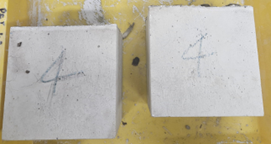
Following the successful implementation of PCR concrete, recent research has focused on the total elimination of cement to develop greener, ultra-low-carbon cement-free concrete. The focus of this study was to develop various cement-free concrete (also known as alkali-activated materials or geopolymer concrete), specifically focusing on blends of GGBS and MK. These binders, when combined with alkali activators, produced concrete that replicates, if not improves, the structural properties in comparison with 100% cement-based concrete. A major practical advantage is that all mixes were successfully developed at room temperature, circumventing the need for high-temperature curing, which has been reported as a drawback of cement-free concrete. Furthermore, all mixes had very good workability, which is crucial for pumping on-site during construction projects. Figure 1 shows concrete samples containing 50% GGBS and 50% MK
Testing and strength
All mixes were prepared and tested in accordance with the established international standards BS EN 12350-1, 2 & 5, BS EN 206-1, and BS EN 12390-1, 2, 3 & 4. Durability (sulphate resistance) testing followed ASTM 1012. The mixes demonstrated excellent workability, mechanical strength, and resistance to sulphate attack.
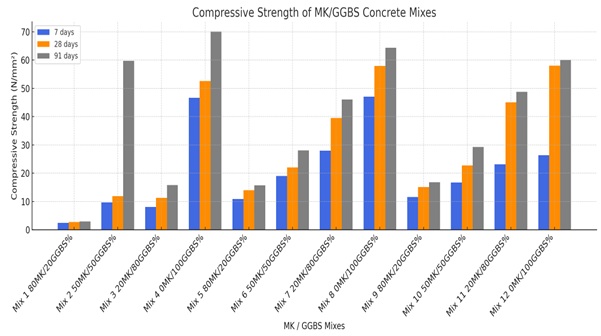
Figure 2 below shows the results of compressive strength testing for different MK/GGBS combinations. As can be seen, a wide range of strengths were developed, varying from 15–70 MPa, which is well within the classification of concrete strengths specified in BS 8500 for major structural and construction applications.


Potential applications
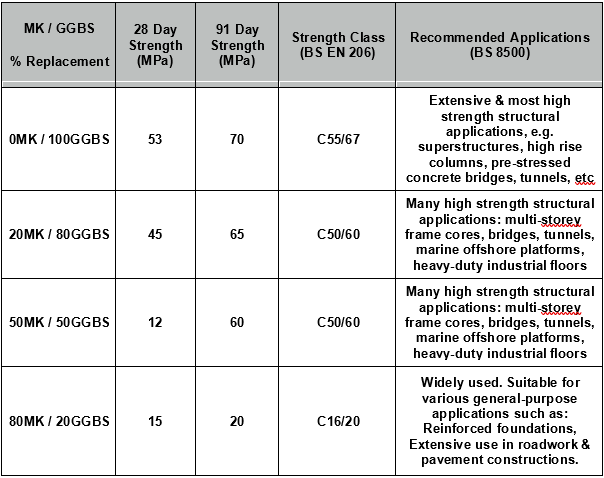
Depending on the mix, the blends developed can be utilised for a variety of civil engineering and construction applications, as summarised in Table 1. Based on their performance and classification under BS 8500, the cement-free mixes are suitable for applications ranging from high-rise columns, tunnels, and bridges (C67 classification) to pavements and roadworks (C20). The high early and long-term strength, combined with environmental benefits, position these mixes as viable commercial solutions.
Durability under sulphate attack
Equally as important as strength, if not more critical, is the long-term durability (robustness) of a concrete structure. One of the most important parameters in service is the concrete structure’s resistance to sulphate attack. This is imperative to avoid premature failure, which could lead to catastrophic structural collapse and fatalities, as seen with the Morandi Bridge disaster in Genoa, Italy, in 2018, resulting in the loss of over 40 lives.
As a result, comprehensive sulphate attack resistance analysis was conducted. Sulphate solutions occur in areas where soils or groundwater have been contaminated. As a result, sulphate-resisting concrete is widely used in any areas that are known to be contaminated with sulphates or any areas where future sulphate exposure is likely; this is a global issue. If sulphate attack is severe, it will result in strength deterioration over time, which can significantly compromise the structural integrity of concrete. In this study, as shown in Table 2, the cement-free GGBS-MK concrete mixes outperformed control 100% cement mixes by demonstrating significantly lower strength deterioration when exposed to Na₂SO₄ and MgSO₄ solutions. The improved resistance is due to denser microstructures and refined pore networks induced by pozzolanic reactions resulting from using GGBS and Metakaolin.
Reflections from DCW 2025
Presenting at Digital Construction Week allowed the authors to engage with experts and innovators who are driving the digital and sustainable transformation of the built environment. From AI-enhanced design tools to carbon tracking platforms, it was observed how digital technologies are accelerating the adoption of low-carbon materials in practice.
Conclusion
The research findings in this paper showcase that industrial by-products such as GGBS and MK can be engineered into cement-free concrete systems that meet and exceed conventional performance benchmarks. Research continues by the authors developing various other formulations of cement-free concrete. The key takeaway from DCW 2025 is that sustainable innovation is not just a laboratory concept—it is ready for real-world adoption, and collaboration between academia and industry will be vital in scaling these solutions.
About the Authors (from Sustainable Materials Group, Leeds Beckett University):
- Noor Alawi ([email protected]) is a PhD researcher, specialising in sustainable construction materials.
- Dr. Ash Ahmed ([email protected]) is a Reader (Associate Professor) in Civil Engineering Materials.
- Dr. An Huynh ([email protected]) is a Senior Lecturer in Materials & Structural Engineering.
- Habiba El-Gharably ([email protected]) is a KTP Research Associate.
- Dr. Sonny Obanore ([email protected]) recently gained his PhD in waste management.
Together, their multidisciplinary work aims to lead the construction industry towards a low-carbon future.