The future of collaboration: Extended reality at KPF
For many architects, extended reality (XR) feels like a frontier just out of reach – one that demands custom software, steep learning curves, and major shifts in workflow. But Anna Mytcul, a Visualization Specialist and Architectural Designer at KPF London, is challenging that assumption. In her recent presentation at Digital Construction Week 2025, titled The Future of Collaboration: Extended Reality at KPF, she demystified XR as a tool that is not only accessible but transformative. Let’s get into it.
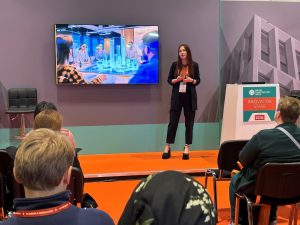
Photo by Stefanos Chrysanthou
Rather than treating XR as a high-tech add-on, Mytcul champions its integration into everyday design workflows. Her approach reveals how existing tools available in the Meta Store – such as Arkio, Sentio VR, Innoactive, and ImmerGallery – can be adapted for architectural use, offering immersive, collaborative, and scalable solutions for teams and stakeholders. Through practical case studies from KPF projects, Mytcul illustrates how virtual and mixed reality can enhance decision-making, streamline communication, and empower non-experts to engage meaningfully in the design process.
Breaking the myth: XR doesn’t require bespoke software
One of the central misconceptions Anna addresses is the belief that XR applications in architecture require bespoke development. “Most architects assume XR means you need to build everything from scratch,” she explains. “But the reality is that we already use tools that allow us to jump into virtual reality literally in one click – we just need to learn how to set them up once.”
At KPF, Anna leverages readily available software – such as Enscape, D5, Twinmotion, Unreal Engine, and Meta Quest headsets – to bring architectural models into immersive spaces using a simple workflow. By translating existing BIM and 3D models into interactive experiences, KPF can transform traditional meetings into collaborative XR sessions.
The result? Less friction between disciplines, faster design iterations, and a greater ability to communicate spatial concepts to colleagues, clients, stakeholders, and the public.
Case Studies: From public consultations to boardrooms
In the 176–178 York Way project highlighted during her talk, Mytcul described a recent public consultation where residents were invited to explore a proposed development in VR. Rather than being limited to static renders or PDF plans, attendees donned headsets and “walked” through the proposed building and explored the future public realm. The feedback was immediate and nuanced.
“People commented on how it felt to be in the space,” she recalled. “They noticed things like how light entered the future public space and had a chance to locate their home in relation to the new development. These are details that rarely come through in 2D visuals but are instantly clear in VR.”
Internally, KPF also uses XR to facilitate design reviews. With collaborative platforms like Arkio – which supports multi-user VR experiences – remote teams can now meet inside the design model, making decisions in real time. This shift has led to greater consensus, reduced miscommunication, and a stronger sense of shared ownership among stakeholders.
Game design meets architecture
A key pillar of Mytcul’s work is blending game design principles with architectural modelling to streamline XR implementation. Many of the challenges architects face when using XR – such as mobile device limitations, model complexity, and constrained interactivity – can be addressed by adopting cloud streaming workflows and simplifying models for better performance.
“We need to understand our end users in order to choose the best software and workflow for an interactive experience,” she said. “Games have taught us that adding simple animations and ambient sound can drastically increase the immersiveness of even a basic VR panorama tour.”
Diagram by Anna Mytcul
By optimizing models for real-time performance, using 360° panoramas to guide user experience, and selecting the right tools for the project, Mytcul creates XR experiences that are both technically efficient and emotionally compelling.
Challenges and limitations
While the benefits are clear, Mytcul doesn’t shy away from addressing XR’s limitations. Hardware costs, user accessibility, and the need for basic digital literacy among stakeholders all pose challenges. There’s also the issue of file size and interoperability between software – a perennial pain point for large-scale architectural models.
Moreover, not all clients or communities are immediately comfortable with XR technologies. “There’s still a psychological barrier,” Mytcul acknowledged. “Some people are hesitant to wear a headset or feel unsure in a virtual space. We need to create XR experiences that feel natural and supportive, not overwhelming.”
To address this, KPF explores the use of augmented reality on iPads or casting experiences from the Meta Quest headset onto large display screens for group settings. This allows XR content to be experienced collaboratively without isolating participants.
A new era of democratic design
At the heart of Mytcul’s work is a broader vision: to democratize design through accessible technology. As a Fulbright scholar and recipient of the Erasmus+ award, she has long explored the intersections of education, play, and architecture. Her earlier research, ARchitect: An Accessible Tool for the Democratization of Architectural Design, presented at ACADIA 2021, emphasized how XR – combined with tabletop gaming – can help non-experts engage with single-family house planning by playing it.
“Architecture has traditionally been a top-down discipline,” she said. “But tools like XR allow for a more horizontal process – one where communities can truly participate in shaping their environment.”
This ethos informs her approach at KPF, where XR isn’t just a visualization tool, but a medium for storytelling, empathy, and inclusive decision-making.
Looking ahead
Mytcul believes XR is poised to become a core part of every architect’s toolkit – not as a niche skill, but as a natural extension of the design process. To make this a reality, she advocates for training programs that integrate game engine workflows into architectural education and for studios to adopt iterative, experimental mindsets.
“The future of XR in architecture isn’t about spectacle,” she concluded. “It’s about collaboration. It’s about clarity. And it’s about making better decisions – together.”
AI generated image by Anna Mytcul
As the industry continues to evolve, her work stands as a compelling example of how immersive technologies can bridge the gap between architects, clients, and communities – creating not just better buildings, but better conversations.