Digital Transformation and Building Information Modelling (BIM) have long been associated with the design and construction phases of the built environment’s life cycle.
However, one crucial stakeholder, the ultimate stakeholder, has historically received far less attention, the asset owner or operator. For years, their needs have been underrepresented in the digital transformation conversation.
But is this finally changing?
The 7 key stages of the data and information lifecycle
- Creation & Capture
- Storage
- Processing
- Usage & Analysis
- Sharing & Distribution
- Archival
- Disposal
Aligning project management frameworks with the data lifecycle in new builds and refurbishments
Within the context of a new build or refurbishment project, these seven key stages align well with established project management frameworks. Furthermore, the data lifecycle is supported by a growing ecosystem of existing and emerging technologies, enabling more efficient, collaborative, and informed decision-making throughout a project’s timeline.
However, for asset owners of our built environment, the data management process presents additional complexities, most notably, the long-term stewardship of data and information. Asset owners must manage and maintain accurate, accessible, and usable data over extended periods, often spanning several decades, and in some cases, over a century.
The asset management landscape is highly complex, encompassing forty distinct focus areas as identified by the Global Forum on Maintenance and Asset Management.
These include essential activities such as
- Contingency planning and resilience
- Lifecycle value realisation
- Asset creation and acquisition
- Asset data and Information management
All while ensuring you maintain strict compliance with regulations and health and safety standards.
One of the main challenges is maintaining accurate, up-to-date information that reflects the current state of physical assets, ensuring data quality is sufficient to support strategic decision-making.
Delivering asset data at the conclusion of a capital investment project is becoming increasingly standard practice, particularly in the UK where the Building Safety Act emphasises the need for a “golden thread” of information.
Standard schemas like COBie or similar can support this process, enabling consistent data transfer from construction projects to facility or asset management teams. Organisations may propose bespoke requirements or align data capture with Enterprise Asset Management Systems (EAMS).
While the initial acquisition of this data is becoming more straightforward, the ongoing challenge lies in ensuring its longer-term quality and maintenance. Asset owners must prioritise the upkeep of this data if they hope to retain the value of the efforts and investments made during the capital investment project’s lifecycle.
When a project is handed over, the asset data usually reflects what was installed at that moment. But if a piece of equipment is replaced during the defects period and details like the new serial number, installation date, or cost aren’t recorded or updated in the central system, the asset data becomes inaccurate and unreliable.
The bathtub curve: Key insights for reliability engineering and deterioration modelling
There is a common graph used by those conducting reliability engineering and deterioration modelling known as the bathtub curve.
This model describes how a component’s failure rate changes over its lifecycle. In the early phase, the failure rate starts high as defective components are identified and removed, and initial manufacturing or performance issues are addressed. During the mid-life stage, the failure rate stabilises and remains constant.
Finally, in the later stage, the rate rises as components wear-out and reach the end of their life expectancy. If relevant and accurate data isn’t consistently collected throughout this lifecycle, the resulting asset dataset will fail to reflect the actual condition or even existence of the components. Over time, data quality deteriorates, eroding trust and rendering the information obsolete.
Ultimately, asset owning organisations face the costly necessity of conducting full-scale asset surveys across entire portfolios, an expense that could have been avoided with effective, long-term data management practices.
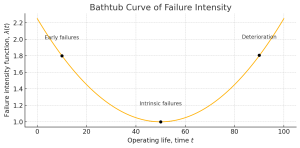
Figure 1: Bathtub Curve of Failure Intensity
Emerging technologies shaping digital transformation
This naturally leads us to today’s existing and emerging technologies. Digital Twins, artificial intelligence, telemetry and sensors to name just a few. These transformative tools have the potential to reshape the trajectory of Digital Transformation and Building Information Modelling (BIM).
With these advancements, asset and facility management can be approached in new, more dynamic ways, directly influencing how we oversee and maintain our built environment. The future shift may include moving towards predictive maintenance strategies, AI-assisted compliance checks for health and safety, and digitally enabled or even automated walk-by condition inspections.
Future advancements hold the potential to fundamentally reshape asset-owning organisations. Rather than continuing to rely on isolated point solutions, such as maintenance management, space planning, or document control, we are moving toward more integrated, intelligent, and proactive management systems.
By significantly improving the long-term stewardship of data and ensuring its reliability, we can revolutionise the way we manage and operate the built environment for generations to come.
Meet the Symetri team on stand D315 at Digital Construction Week, taking place at Excel London on the 4-5 June, 2025.
Register for your free ticket here
About the Author
Daryn Fitz is a Principal Consultant and Special Projects Lead at Symetri, with over 35 years of experience across design, construction, and development organisations. Since joining Symetri in 2013, he has specialised in technology strategy, implementation, and project delivery, often serving in roles such as client advisor or information manager.
Throughout his career, Daryn has been dedicated to helping organisations maximise the value of digital tools and data. His current focus is on supporting asset-owning organisations to improve their information and data management practices, from capital investment project delivery and handovers to day-to-day reactive, planned, and preventative maintenance operations.
In addition to his consultancy work, Daryn serves as the technical advisor for LRQA’s ISO 19650 company certification scheme. He is also a regular university lecturer and an active member of the Institute of Asset Management, where he contributes to advancing industry thought leadership.