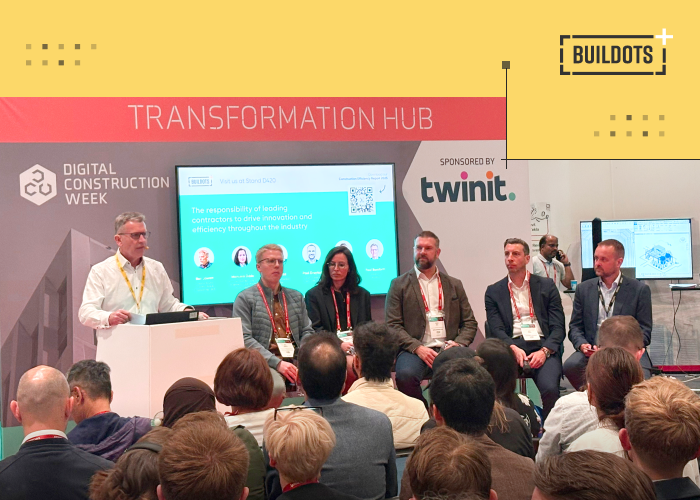
It’s not every day you get to sit with a group of leading contractors willing to candidly share the challenging, complex, and often underappreciated realities of driving digital change in construction. But that’s exactly the opportunity we had at this year’s Digital Construction Week.
I had the pleasure of moderating a panel called “The responsibility of leading contractors to drive innovation and efficiency throughout the industry”, joined by forward-thinking professionals Colin Bell (Kier), Nick Leach (Sir Robert McAlpine), Paul Drayton (Laing O’Rourke), Manuela Oddo (Mace), and Dr Ben Jowett (SES). What followed was a frank conversation about what it really takes – not just experimenting with new tech, but embedding meaningful change across entire businesses.
Here are five key lessons from that session, highlighting both the influence and the responsibility contractors have in shaping innovation across the construction industry.
First, bring out your dead
Before you invest in anything new, take stock of what you already have – and what needs to go.
Colin Bell kicked things off with a simple truth: most contractors are sitting on a patchwork of duplicated and underutilised tools. That’s why his team used a company-wide software audit – what they called “Bring Out Your Dead.” The idea was to surface all tools in use, regardless of who brought them in, and assess where duplication, redundancy, or confusion had crept in.
It wasn’t just about eliminating tools. It was about restoring visibility, reducing noise, and creating space for the right solutions to take root. It also allowed them to align tools with project types and introduce governance, so future tech adoption followed a clear process rather than an ad hoc one.
Be a friend – and a foe
Digital teams often sit between two worlds: operations and innovation. That means they need to do two things really well – listen and challenge.
Nick Leach described digital as an enabler function. His teams are embedded on projects to help teams adopt tools that improve delivery. They work alongside project teams to understand real pressures and make technology part of the day-to-day, not an extra burden.
But being a friend sometimes also means being a bit of a foe. Both Colin and Nick spoke about the importance of pushing back against “tech for tech’s sake.” The role of digital isn’t just to support, it’s to protect teams from unnecessary complexity and ensure every tool serves a clear operational purpose.
Dr Ben Jowett summed it up well in his reflections after the panel: digital change isn’t about mandates – it’s about momentum. That means prioritising invitation over imposition, exploration over explanation, and authenticity over authority. People are far more likely to engage when they feel involved, not just instructed.
All the panelists agreed – the balance only works when Digital, Ops, and Tech providers work in partnership, each bringing their lens to shape practical, valuable solutions.
Repetition is key
A new tool doesn’t stick just because it’s been introduced. Often, it doesn’t stick the second or third time either.
Nick made it clear: most initiatives stumble on the soft side of digital change. You can’t show someone a new platform once and expect it to become routine. That’s why SRM developed a software handbook, now evolving into a searchable internal catalogue, to help teams understand what tools are available, how to use them, and what outcomes to expect.
Kier takes a similar approach, maintaining standard operating procedures for each tool, monitoring user engagement, and running monthly KPI reviews with vendors.
Both organisations track adoption metrics – things like frequency of logins and user engagement, and meet regularly with vendors to review uptake. If usage dips, they act early. If a pilot succeeds, they replicate it.
Adoption is a cycle, and repetition is what makes it stick.
Bring every conversation back to value
Paul Drayton from Laing O’Rourke made a simple but powerful point: “Don’t start with features. Start with value.”
When you’re trying to secure buy-in, whether from site staff or senior leadership, the worst place to begin is with a feature list. People want to know what’s in it for them. Will it save time? Reduce errors? Streamline reporting? Improve collaboration?
That answer will vary by role. For a planner, it might be tighter lookahead coordination. For a director, clearer oversight. For execs, the ability to benchmark performance and risk across projects.
Start there, and the rest follows.
Pick your battles – not every problem needs tech
Not every problem is best solved with software.
Manuela Oddo reminded us that tools can’t fix broken processes. That’s why tech selection should start with a pain–gain analysis. What’s the problem? Who’s affected? What’s the value if we solve it, and what’s the risk if we don’t?
Dr Ben Jowett noted that this process is formalised. New ideas go through internal governance. If a tool already exists that solves the issue, they use it. If not, and the value is clear, they begin a structured pilot. Only after validation, onboarding, and usage tracking does a tool move into the tech stack.
Ben further highlighted a critical consideration: interoperability. Without it, even the best tools risk becoming isolated silos. And when data can’t flow between systems, the wider value it could unlock across a business is lost. Making sure new tools can integrate with existing ones is essential if we want that data to work harder for us.
Manuela emphasized the importance of choosing pilot projects strategically and scaling only what truly works. It’s not just about the outcomes, but also about understanding the effort required to achieve them. Was it repeatable? Is it scalable? Those are the questions that matter.
This approach ensures that innovation isn’t just exciting, it’s sustainable.
What’s next?
What this panel made clear is that innovation isn’t about chasing the next big idea – it’s about creating the conditions where good ideas can thrive.
That means knowing what tools you have. Building strong partnerships between Digital, Operations and tech providers. Establishing repeatable processes. And anchoring everything in measurable value.
There’s no single playbook. But there are lessons and the industry is learning them, one step at a time, from the ground up.
About Paul
 Paul has over 30 years of experience running and advising software companies servicing the UK construction industry. Throughout his career, he’s built a strong understanding within both the infrastructure and building sectors, with a particular emphasis on how digital technologies can drive much-needed improvements in construction productivity and efficiency.
As Head of Global Strategic Accounts at Buildots, Paul is focused on ensuring the partnership between each client and Buildots delivers meaningful value, specifically by turning project data into process improvements that drive better margins and business growth.
About Buildots
Buildots is a global construction technology leader bringing the power of AI and computer vision to automate on-site progress tracking. Buildots transforms construction management by unlocking accurate data and predictive performance metrics. Its game-changing AI assistant, Dot, can even answer project questions through simple conversation.
This empowers construction teams to make truly performance-driven decisions for the first time. With the platform, Buildots’ clients – top global contractors, consultants and owners – get more visibility, greater efficiency, up to 50% fewer delays and a higher chance of successful project delivery.