
Offering real-life insights into a more integrated, productive future for the construction industry – and a glimpse of what lies ahead – Stuart Campbell, Enterprise Sales Manager at Trimble, the global construction industry technology provider, delivered a compelling seminar at this year’s Digital Construction Week. His session highlighted an industry at a crossroads. One side with embedded inefficiencies, siloed data and a persistent skills crisis. The other, the transformative potential of connected workflows that unite information, people and processes across the full project lifecycle.
The cost of a disconnected reality
There are two key challenges facing the industry. The first is the skills gap.
Referring to research, stating that 40% of skilled workers are anticipated to leave the sector by 2031, with 81% of construction firms struggling to find qualified workers, it is clear that significant amounts of knowledge, skills and experience will no longer be accessible to the industry.
The second challenge is the data gap, with construction projects often operating within fragmented systems, where data doesn’t flow seamlessly between teams. Even though many design offices embrace 3D modelling and BIM, site teams often remain anchored in 2D workflows. This can result in mismatched expectations, delayed decisions or costly reworks.
Research highlighted that poorly documented or out-of-scope work can result in revenue losses of 7-11% per project.
What’s more alarming is how these two crises, the skills gap and the data gap, compound each other. Inconsistent workflows and inaccessible information leave even experienced workers at a disadvantage, let alone those entering the field with limited practical training.
Align technology with the ‘reality’ of construction delivery
Workflows connected through technology bridge this gap, not by simply digitising the current situation but by rethinking how teams collaborate, starting with people.
It’s a mindset shift as much as a technological one. From field systems and surveying hardware to AECO software for design, engineering, construction management and transportation, through to site handover and long-term asset management. Rather than forcing teams into rigid tools or formats, the focus is on aligning technology with the realities of construction delivery.
One standout example of acknowledging the reality of where its employees were, came from a precast manufacturer customer. An initial push to transition its rebar cage fixers directly to 3D modelling fell flat. Recognising its team’s reliance on 2D drawings, a subtle, user-led innovation kickstarted adoption. A QR code was printed with 2D drawings linked to the 3D model, over time workers began scanning them voluntarily and eventually this system bypassed the drawings entirely. It was a gradual evolution based on understanding the people involved, not just the systems.
First things first
At the other end of the digital approach is the renowned Hinckley Point C project, where a tailored digital strategy was developed around site-specific construction constraints, workforce experience and compliance requirements. Dr Andrew Jackson, Technical Director from the project’s main civil works contractor, BYLOR, summarised the ethos at a previous Trimble event, saying: “Don’t ask what digital tools you can use. Ask what construction challenge you’re trying to solve.”
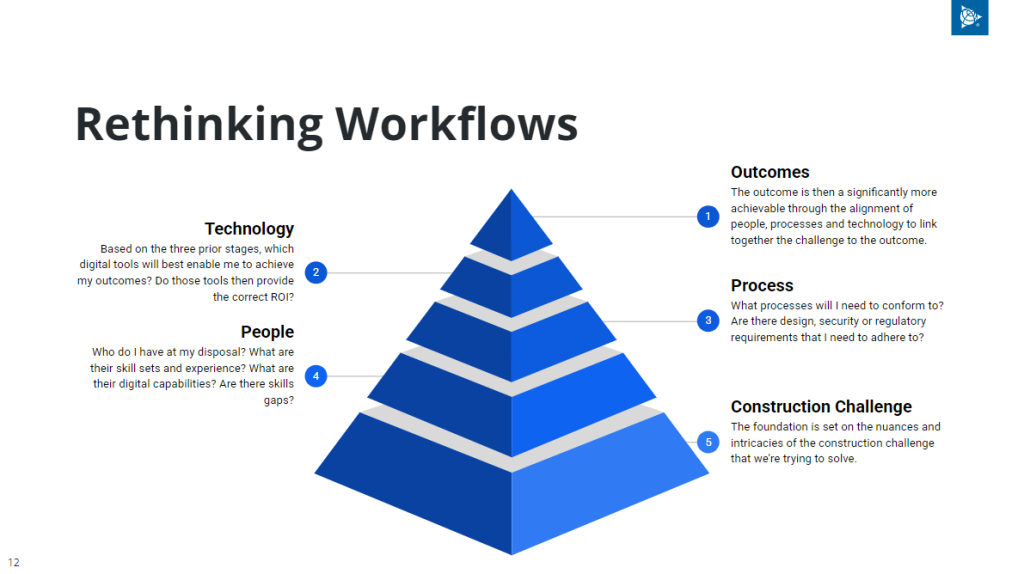
This problem-led tactic repositions digitalisation as a response to reality, helping users access, interrogate and act on information at the right time and place. It’s all about picking the right software or hardware ‘tools’ for the job throughout the project’s lifecycle. The solution can be built up like a pyramid, as illustrated in the diagram.
The foundational layer begins with a clear understanding of the construction challenge: What needs to be achieved, within what timeframe, and under what budget constraints?
Next, consider the people – who is involved in the project, both on site and off, and what are their current skills and familiarity with digital tools.
Then turn attention to the processes required for delivery. What standards, regulations, and design codes, including relevant ISO requirements, must be followed to ensure the project is completed safely, accurately, and on time?
These three foundational areas will then shape the choice of technology that gets used on-site.
Augmented Reality (AR) and the site of the future
While many in the industry still wrestle with adopting cloud collaboration tools or consolidating design files, Trimble gave attendees a glimpse into what’s coming next. Augmented reality headsets like Microsoft HoloLens are already enabling real-time Quality Assurance (QA) walk-throughs, geolocated model overlays, and progress monitoring against as-built scans.
As the company has demonstrated at its own Leeds office site, AR has been used to visualise pipework and ducting, test clash detection in situ, and plan logistics such as crane access and scaffolding zones. A live point cloud scan was imported, reviewed, and modified collaboratively across different design platforms, as might happen on a real project.
This isn’t just about fancy tech. It’s about removing friction. No more manual measuring or waiting for printed plans to arrive. No more misaligned assumptions between design and delivery. Just one version of the truth that is visual, verifiable, and usable on-site.
Interoperability is the cornerstone
The construction industry doesn’t operate within a single software ecosystem. Trimble acknowledges this reality, reaffirming its commitment to open BIM and data integration. A hybrid toolset is essential – SketchUp for layout, Tekla for structural detailing, Revit for MEP coordination, it goes on. What matters is not which tools are used, but how well they speak to one another.
This philosophy is what turns a ‘connected workflow’ from a buzzword into a strategic action plan. Connected doesn’t mean everything is uniform, it means information flows from design intent to build verification, from field sensors to finance dashboards.
Looking ahead to productivity per worker
With fewer skilled people entering the industry, productivity per worker is becoming a defining metric. Digital tools must now empower fewer people to do more, safely, accurately and consistently. Whether through robotics, automation or real-time performance monitoring, construction is catching up with manufacturing’s long-standing productivity gains – albeit the two sectors are vastly different.
In manufacturing, digital transformation is decades ahead, but with the acceleration of site-ready tech, intuitive interfaces, and AR/VR solutions, the gap is narrowing fast – as demonstrated by the Trimble Dimensions experiment in the USA. Here, an entire job site was filled with driverless diggers, each working on their own, hints at the construction sites of the future.
Much of this technology already exists, but adoption is uneven. The real task ahead is not just rollout, but culture change – rethinking workflows, reskilling teams, and rebuilding trust between field and office through data.
Commitment to collaboration
The message from Trimble’s seminar was clear. The industry’s fragmentation is fixable. But it requires more than software. It demands a commitment to clarity, context, and collaboration. Connected workflows are not just technical upgrades; they’re a new foundation for project success in a sector under pressure to deliver more with less.
As margins tighten, workforces evolve and client expectations grow, firms that embrace this mindset shift, aligning tools with tasks and data with decisions, will be the ones still building five years from now.
For more information about Trimble software and hardware solutions, please visit: https://get.trimble.com/cons-discover-solutions.html