
Digital Construction Week (DCW) 2025 marked its 10th anniversary with strong momentum. As a participant and panellist, I left reflecting not just on how much technology has advanced, but on how we’re transforming the way we work, connect, and deliver projects.
One thing that stood out was the honesty in conversations at the Revizto booth. These weren’t about distant roadmaps or marketing spin, they focused on real challenges and a shared ambition to improve how we work. It’s always exciting to meet so many people eager to collaborate and tackle the complexities of digital construction. It’s been an exciting journey, and we’re just getting started!
From curiosity to commitment
I’ve been coming to DCW for 10 years. The first few were when I was at Arup (Oasys); the last 8, in my role at Revizto. I vividly remember the early conversations when introducing Revizto to DCW’s audience. People would ask me:
- “Why have you left Arup?”
- “What is Revizto?”
- “Is this technology really necessary?”
Fast forward to today, and the tone couldn’t be more different. Now, the questions at DCW sound like:
- “We need a high level of collaboration now. Can we meet next week?”
- “I saw what you’re doing with [company]. How do we get started?”
It’s been remarkable to witness and be part of this shift from digital hesitation to digital urgency. Where I once had to convince people why change was needed, now they come to DCW looking for partners to help them lead it. The AECO industry isn’t stuck in the past. There are plenty of people and firms pushing boundaries and driving meaningful innovation. They’re the ones who make DCW so dynamic, proving that construction is forging a path to the future.
DCW: A platform for change
DCW is where I’ve met some of the most influential collaborators and closest industry allies. These connections have led to powerful partnerships, my amazing team, and game-changing ideas. For many of us, DCW is also a place to build our brands, personally and professionally, encouraging us all to step up, share, and think differently.
What’s always struck me about DCW is its power to drive disruption in the best possible way. The event provides a platform to challenge norms, raise the bar, and help the industry break free from legacy thinking.
It’s also where I’ve had the privilege to showcase some of the best digital applications on some of Europe’s most ambitious projects. Not through flashy demos, but through real life conversations co-told with our partners who are able to share real outcomes. No sales pitches, they’re shared experiences of learning what works, what doesn’t, and what’s possible.
Some of the most inspiring moments this year came at the Revizto booth. I feel like I spoke to 5,000 people but a few conversations stayed with me, like one with Andy Boutle from ALEC, whose leadership in digital delivery continues to set a regional benchmark. I also managed to get some time with Nuzrul Haque, Rachael Atkinson and other members of the AtkinsRéalis team, whose strategic outlook is helping shape how large organisations approach sustainability and data-led delivery.
These aren’t isolated conversations or stories, they’re part of a wider movement that DCW helps energise each year by connecting us all.
The bigger picture
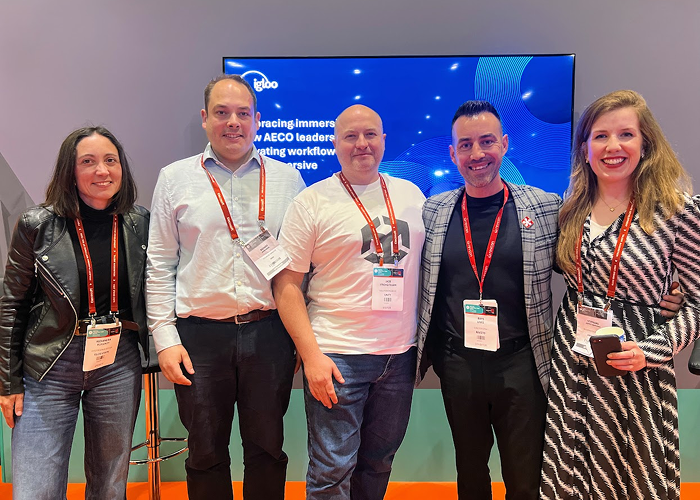
I was honoured to participate in a panel hosted by Igloo, “Embracing Immersive: How AECO Leaders Are Elevating Workflows with Immersive Technology,” sharing my perspective on where the industry is heading and the challenges people face on the ground.
I drew on key insights from our recent “Bridging the Gap: The 2025 Digital Design & Construction Report” which captures perspectives from a global survey of industry leaders. One of the most striking insights was that the number one business challenge cited by respondents was technology integration and adoption.
Even more telling, the biggest barrier to tech adoption isn’t budget – it’s the time needed to implement new tools and train teams. Even in 2025, 27% of teams still rely on email, Excel, and PDFs for project delivery, which is a stark reminder of just how much room there is for improvement!
So, what does this mean? There’s a real appetite for the right tools. We’re moving beyond the inertia that’s traditionally slowed digital transformation. But it’s not enough to just offer powerful software; it needs to be easy to use, fast to implement, and deliver real ROI.
I’ve spoken with many CIOs facing pressure to cut costs and maximise efficiency. When they evaluate solutions, they’re not just considering the features. They’re evaluating how quickly their teams can learn, adopt, and integrate them into their workflows. That’s where the real value lies; in the transformation tech empowers.
Looking ahead
After 10 years of attending, I can confidently say that Digital Construction Week is one of the most powerful enablers of change in our industry. It’s helped me grow, helped my teams connect, and helped our sector move forward.
Whether you come to learn, share, question, network or challenge, this event gives you the platform to do it. And in a world where the pace of change is only accelerating, that kind of platform is more valuable than ever.
About the Author
Rhys Lewis is a leader in the Architecture, Engineering, Construction and Operations (AECO) industry, with over 20 years of experience driving innovation through technology. As Director for EMEA at Revizto, he has played a key role in scaling the business and building high-performing teams. Passionate about challenging the status quo, Rhys specialises in bringing disruptive solutions to market, redefining industry workflows, and accelerating digital adoption at scale.
Before Revizto, Rhys was a member of the global team at Arup, where he successfully took several products to market, built a global network, and developed strategies to navigate complex regional workflows. His track record for scaling businesses, challenging outdated processes, and striving for efficiency has made him a trusted advisor and thought leader in construction technology. Rhys is also a respected industry advocate actively involved in formidable industry bodies like nima (formerly the UK BIM Alliance), where he champions collaboration and digital transformation to improve the built environment.