In this guest blog, Umesh Bhutoria, Founder and CEO of Xempla explores key takeaways from Digital Construction Week, challenging the industry to go beyond surface-level digital enhancements and embrace true transformation. From AI and predictive maintenance to Smart FM and business model innovation, they ask the crucial question: are we building for the future, or simply modernising the past?
The familiar echo of innovation
Digital Construction Week showcased a dazzling array of technological innovation – AI-powered solutions, machine learning applications, and digital twins that promise to transform how we build and operate facilities.
Yet, beneath the gleaming surfaces, a nagging question persisted for me: are we truly transforming, or simply enhancing the familiar?
While the technology has certainly evolved, many of the underlying processes and strategies looked remarkably similar to approaches we’ve been using for years – just with more sophisticated tools and terminology.
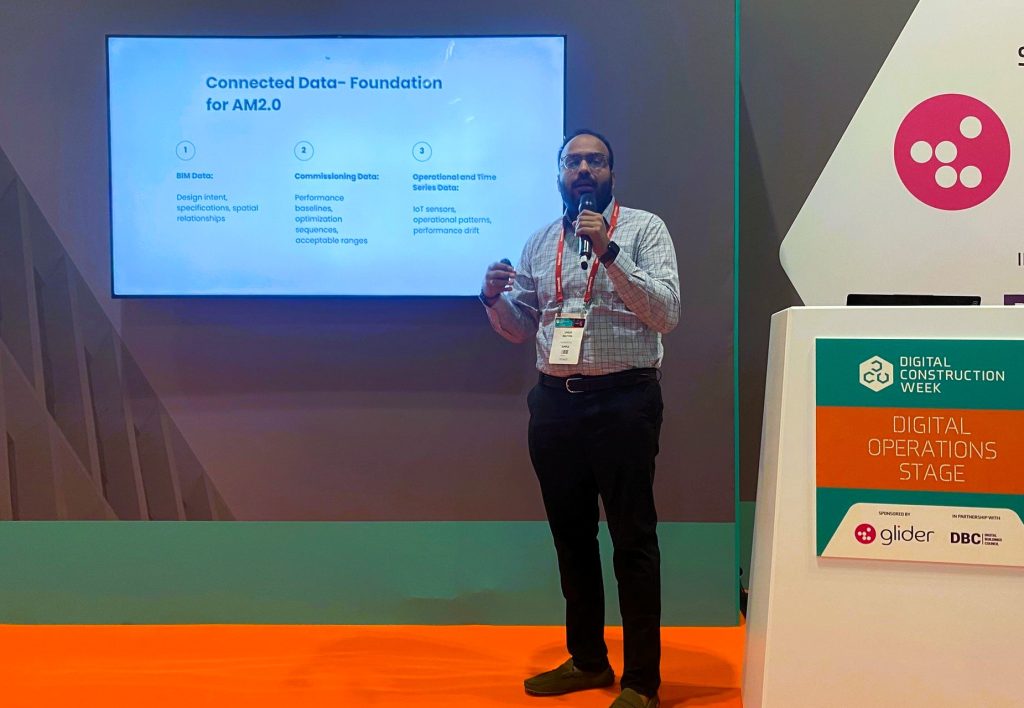
The evolution question: enhancement or transformation?
If our fundamental processes and strategies remain largely unchanged in this “AI-first world,” what does that tell us about our industry’s readiness for transformation?
It’s not necessarily a criticism – there’s wisdom in building upon proven foundations. But it does suggest we might be in more of an enhancement phase rather than a true transformation phase.
Beyond AFDD: towards autonomous maintenance
Take Automated Fault Detection and Diagnostics (AFDD) as an example. One consulting firm’s insights on this technology highlighted both the promise and the current reality.
Here’s where we need to step back and think from first principles: AFDD, Condition-Based Maintenance (CBM), and Predictive Maintenance (PDM) are all valuable tools, but they’re components of a much larger vision – autonomous maintenance.
Instead of taking a piecemeal, use-case approach, we should be asking: how do these technologies work together to create self-maintaining facilities that require minimal human intervention for routine operations?
AFDD becomes far more powerful when it’s part of an integrated ecosystem that can not only detect faults but automatically resolve many of them.
Predictive maintenance: success, but still reactive
Predictive maintenance continues to be the standout success story in smart building technology, with impressive 40% year-over-year growth that demonstrates real market adoption and ROI.
But again, we’re falling into the same trap – optimising individual processes rather than reimagining the entire maintenance paradigm. Predictive maintenance is excellent, but it’s still fundamentally reactive thinking. We predict, then we respond.
The bigger question: why aren’t we designing buildings that maintain themselves?
The technology exists – IoT sensors, automated systems, AI decision-making – but we’re counterintuitively bringing human effort and involvement into every point of the process rather than removing it where it’s not needed.
Currently, our dashboards and monitoring systems are actually increasing the workload on senior engineers, who now spend more time interpreting data and alerts than they did managing maintenance schedules. We’ve added complexity without removing the fundamental burden.
The AI digital twin evolution: more complexity, less utility?
The evolution from digital twins to “AI digital twins” is particularly telling – and not necessarily in a good way.
Here’s the uncomfortable reality: most operations teams will never use digital twins in their daily work. They’re complex, require specialised training, and often solve problems that facilities managers didn’t know they had.
We’re pushing shiny new technology without thinking deeply enough about first principles.
What do operations teams actually need? For a select few personas and use cases, digital twins work. For everyone else, it should be as simple as a work order that clearly states what the issue is and what needs to be done, feeding directly into the existing work order management system.
No one needs to look at any other interface, and no change management required, period.
We need to stop asking “how can we make digital twins smarter?” and start asking “how can we make building operations effortless?”
Reimagining FM: the Smart FM imperative
This brings us to the heart of the matter: the transition from traditional facilities management to truly Smart FM – and more importantly, how we bridge the gap between design data and operational intelligence.
Let’s define Smart FM properly: it’s a new operating model that brings together the best of human expertise, data intelligence, and technology (AI included) to deliver 10x better outcomes with significantly improved ROI for all stakeholders.
It’s not about making current FM practices digital – it’s about reimagining what facilities management could be.
Smart FM means buildings + assets + knowledge systems that learn from their own performance, automatically optimise themselves, and require human intervention only for strategic decisions and complex problems.
It means maintenance budgets that shrink while building performance improves. It means facilities managers who spend their time on value-added activities rather than chasing down routine issues.
The construction industry generates enormous amounts of valuable data during the design and construction phases. However, much of this information doesn’t make it effectively into the operational phase, creating a disconnect that Smart FM technologies could help address.
The opportunity isn’t just about better sensors or smarter dashboards – it’s about creating seamless data flows where:
-
Design decisions benefit from operational insights
-
Construction processes preserve and enhance data for operations teams
-
Operations generate feedback that improves future design decisions
-
Each project contributes to collective industry knowledge
The path forward: a business model problem
The observations from Digital Construction Week suggest we’re at an interesting inflection point. The technology capabilities are advancing rapidly, but our industry processes and mindsets are evolving more gradually.
Frankly, nothing pathbreaking emerged from the event. Revolutionary change won’t happen unless we’re prepared to throw away the box entirely, rather than just thinking outside of it.
We’re still trying to fit new technologies into old frameworks instead of building entirely new approaches.
The next phase of our industry’s evolution will require more than technical improvements – it demands business model innovation at every level:
-
Master System Integrators need to move beyond project delivery to ongoing performance partnerships and become part of the operating model
-
FM companies must evolve from service providers to outcome guarantors
-
Technology vendors should shift from selling products to selling results
-
Building owners need to think in terms of total lifecycle value rather than upfront costs
The technology exists to support integrated Smart FM, but our business models are the real barrier. This resistance isn’t accidental; our current business models, often optimised for short-term project delivery and reactive services, inherently disincentivise the long-term, outcome-based partnerships required for true Smart FM.
The financial structures and risk allocations simply aren’t set up for it.
What we’re staring at isn’t a technology problem – it’s fundamentally a business model problem.
Looking ahead
Digital Construction Week showcased impressive technological capabilities – sensors that can predict failures well in advance, AI that optimises building performance in real-time, and digital twins that provide unprecedented insight into building operations.
The foundation for transformation is clearly being laid. The challenge now is to build upon these technological advances with process innovations that fully realise their potential.
The construction industry’s digital journey is far from over, but events like Digital Construction Week show we’re making steady progress. The key is ensuring that as our tools become smarter, our approaches to using them evolve as well.
The future of Smart FM lies not just in deploying better technology, but in creating better connections – between design and operations, between data and decisions, and between the various stakeholders who shape our built environment.
The buildings of tomorrow will be defined by how well we connect today’s innovations with current and upcoming operational realities.