
By Brahm Lategan, Digital Building Consultant
Digital Construction Week 2025 brought together some of the brightest minds in the built environment, and I was honoured to contribute to the conversation. My session explored how digital transformation can be approached holistically starting from the earliest stages of a project and continuing through to operations and beyond. In this article, I reflect on the key themes from my talk, share lessons learned, and offer practical insights for those navigating the digital journey in the built environment.
What Is a Digital Building?
A digital building, as I define it, is one that leverages automation and sensor data from both building and business systems to enhance performance, energy efficiency, and occupant wellbeing. But this definition is fluid – what matters most is how technology serves the people who use the space.
Why Digital Transformation?
The motivation is clear: to optimise energy use, improve comfort and productivity, enhance safety, and enable data-driven decision-making. But the real value lies in ensuring that technology works for us – not the other way around.
“Technology should enrich us and make our lives easier. Technology must work for us – we don’t work for technology.”
The Foundation: Integration and Data
At the heart of any digital building is data. Yet without integration between disparate systems, that data remains locked away. Integration is the linchpin of digital transformation – it enables the convergence of systems and the extraction of meaningful insights.
Lessons from the Field: Principles for Success
Every building is as unique as a fingerprint. Even with identical designs, the people and organisations within them create distinct needs. That’s why a one-size-fits-all approach to digital transformation doesn’t work.
Here are the key principles essential to any transformation initiative:
- “Think value, not tech. Think people, not tools. Set clear targets from the start”.
This ethos, inspired by Henrik von Scheel, keeps us grounded in purpose rather than dazzled by gadgets. - Start with Strategy.
A clear vision and roadmap are essential. Strategy should answer the “why,” “how,” “what,” and “when” before any technology is deployed. - Embrace Change Management.
Technology adoption must be cultural. Unused tech is a dead asset. - Own Your Data.
Data is the oil in the transformation engine. Ownership ensures control, compliance, quality, and the ability to innovate. - Be Iterative and Agile.
Traditional construction methods often clash with agile digital strategies. That’s why digital transformation must begin at RIBA Stage 0 – well before construction design. - Understand It’s a Journey.
Transformation doesn’t end at handover. It’s a continuous process that evolves with the building and its users.
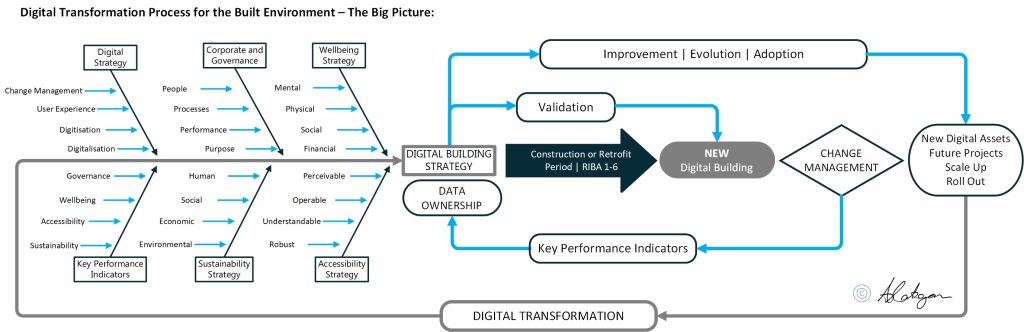
Setting Clear Targets
Many organisations struggle to define outcomes. While KPIs can help, they are not a substitute for strategy. Aligning system design with clear, measurable goals from the outset is critical to success.
Final Thoughts
Digital transformation in the built environment is not about chasing the latest tech trends. It’s about creating spaces that are efficient, sustainable, and human-centric. By starting early, thinking holistically, and focusing on value, we can ensure that our buildings are not just smart but truly intelligent.
About the Author
With over 23 years in engineering and construction, my roots lie in industrial automation and operational technology. I’ve spent 17 years as a systems integrator for building automation, power, and energy management systems, and the past six years in solution and enterprise architecture for commercial real estate, data centres, hospitals, and universities. I act as agnostic digital transformation specialist, helping clients unlock the full potential of their buildings through technology and strategy.
If you’d like to dive deeper into this topic, I’m delivering a course through the Chartered Institute of Building (CIOB) that offers hands-on insights into smart building technologies and strategic planning: https://www.ciobacademy.org/product/digital-transformation-in-the-built-environment/
Contact:
Brahm Lategan
https://www.linkedin.com/in/brahm-lategan/