
This article explores the results of a unique live experiment at Digital Construction Week. By turning audience members into the decision-makers for a fictional digital town, the session tested how well professionals make choices when given goals, context, and options, but no data. The article reveals surprising results and lessons on how creativity and technology can help construction teams make better, more evidence-based decisions.
Virtual Twin Willowford: Instinct is not enough!
Construction is facing some of the biggest decisions in its history. Choices that will shape communities for decades. When I planned my session for Digital Construction Week, I took a risk and ditched the traditional lecture format in favour of an experiment. This experiment had a secret I would reveal to the audience the end.
The session put a group in the decision-maker’s seat. The theory was simple. Could a group of professionals make the best choice for a goal, if they had context, two options, but no supporting data?
Welcome to Willowford

Willowford, my fictional digital twin town of 25,000 residents, was designed to mirror the many small towns across the country. After introducing the Willowford, I handed control to the audience, now the towns mayors, to collectively decide its fate.

They faced three big decisions, each with two options. The choices built on each other, creating eight possible outcomes. Each decision was judged on four key metrics: resident happiness, local economy, environmental impact, and town budget. They voted for each option by a show of hands, but not before I handed the mic over to the mayors to debate.

Scenario 1: Housing – Preservation vs. Progress
Inspired by the challenges our New Towns Task Force faces delivering 1.5 million homes by 2029, it was the classic debate. Progress versus Preservation. The mayors had to tackle Willowford’s housing and homelessness problem. They chose between low-density homes on farmland outside the city, and high-density housing on woodland near the town centre.
Here’s what our mayors said:
- Mayor (Option 1: Low-Density Housing): “We can’t compromise the forest. We should use the open areas, because we can’t disrupt nature.”
- Mayor (Option 2: High-Density Housing): “It just looks better having housing in that location.”
The group supported Mayor 1, choosing to protect the forest.
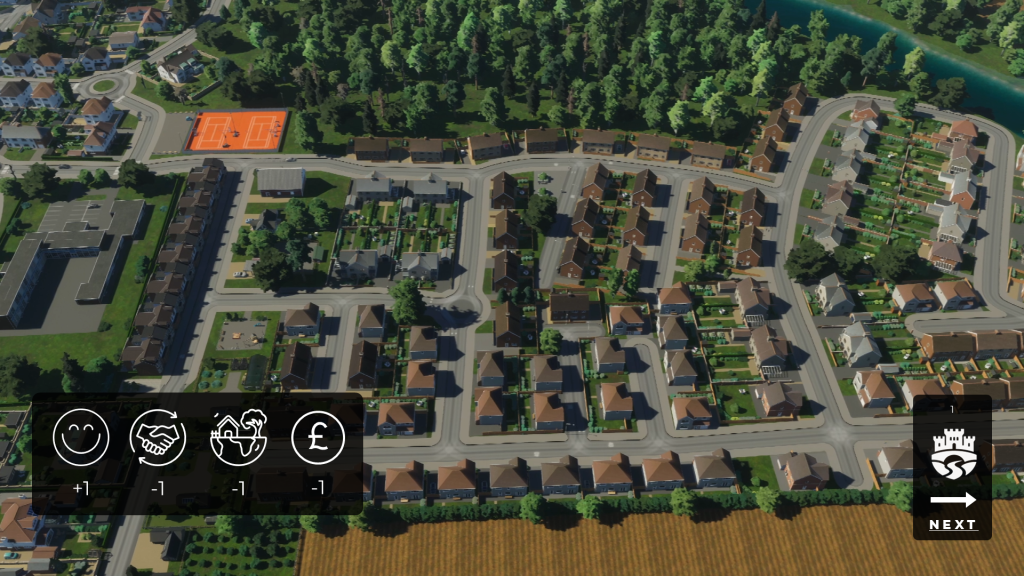
But, this meant far fewer homes were delivered. 200 homes, compared to 2,000 homes for option 2. Those most vulnerable couldn’t afford the new houses, and the town’s growth was restricted right from the start. The mayors shown the scores before voting, to avoid bias.
Scenario 2: Traffic – Planning for Now or the Future?
Traffic is a dilemma we all know too well. Across the UK, ageing road networks struggle to keep up with population growth, economic expansion, and climate change. The National Infrastructure Committee advocates maintaining and upgrading what we have, while governments typically focus on shiny new projects. In Willowford, the mayors needed to relieve permanent congestion frustrating both residents and businesses. Their options: upgrade the old road network or build a new bypass.
The debate:
- Mayor (Option 1: Upgrade Existing Road): “It would be cheaper to upgrade existing roads. We shouldn’t be destroying nature for new roads.”
- Mayor (Option 2: Build New Bypass): “It will create an easier route for traffic now but also provide infrastructure for expand later.”
This time, the group sided with Mayor 2 and built the bypass.
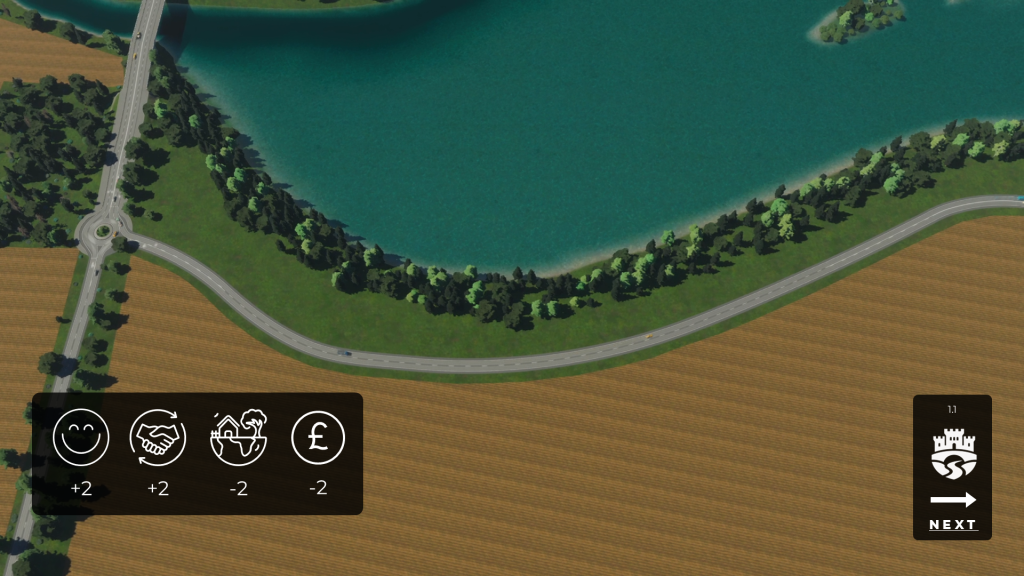
With 10km of new road built, traffic successfully diverted around the lake. This also unlocked space for a future town expansion. The alternative, even with major upgrades (3 roundabouts, 1 underpass, and a new footbridge), did not have solved the congestion.
Scenario 3: Investment – Short-Term Gains or Long-Term Value?
The last scenario, saw the mayors received a cash injection to drive growth in the town. This mirrored real investment schemes like the Towns Fund or the Levelling Up Fund. The mayors had to choose between expanding the industrial business park or building a train station.
The finale:
- Mayor (Option 1: Industrial Park): “We’ve just built a bypass to help the industrial traffic, so it makes sense to focus on expansion. Double down on investment.”
- Mayor (Option 2: Train Station): “A train station brings people in and out, like commuters and tourism. Also, less traffic.”
The final vote saw the group choose the train station.

This brought tourism and helped attract new talent to fill empty job roles. The other option building more business space, sounded good. However, without the population growth to fill new jobs, most would remain empty.
The Compounding Cost of Decisions

Of the eight possible outcomes, the mayors’ decisions placed Willowford, joint fourth.
But what if I’d shared the option scores up front before they chose? What if different Mayors had spoken? Would the group have chosen differently, even if it meant picking an unpopular option, or going against their own beliefs? There’s rarely a perfect answer, just different consequences.
Even with smart decisions later, that first call on housing limited what Willford could achieve. This is something we see in real projects all the time: early decisions echoing through everything that follows. And the cost impact is huge. According to the Get It Right Initiative, avoidable errors cost the UK construction industry over £5 billion each year.
Key Lessons:
- Digital construction makes data visible. So, we’re not just guessing or relying on instinct. With the right data, we can make the best call for the situation.
- The hidden power of a digital twin is as a sandbox. An environment to run scenarios and test ideas without real-world consequences. In virtual reality, we can make mistakes and learn from them. In actual reality, mistakes can be costly, or even fatal.
But there was a secret I kept until the end. Here’s the twist I revealed – Willowford was built using Cities: Skylines 2, a city-building game, not expensive specialist software. We don’t always need big budgets or the latest tech to drive better decisions. Sometimes, thinking creatively with what we already have can make a significant difference.
To build better, we’ll need more decisions made based on goals and data, not habit or gut feelings.
 About the Author
Nathan Reid is a chartered construction manager and digital construction specialist with experience delivering large urban extension and regeneration projects. With expertise in both civil and software engineering, Nathan leads on digital strategy and drives innovation at scale. He’s passionate about harnessing technology, data, and creative thinking to tackle the industry’s toughest challenges.